
International Trade Law: WTO Framework & Policies
Introduction
International Trade Law governs the rules, agreements, and institutions that regulate trade between nations. In an era of globalization, supply chain interdependence, digital commerce, and geopolitical shifts, understanding the World Trade Organization (WTO) framework and global trade policies is essential for policymakers, businesses, law students, and international trade professionals.
This comprehensive guide explores the WTO structure, principles of global trade law, major agreements, dispute resolution mechanisms, emerging trade challenges, and the evolving landscape of international economic governance.
Evolution of the Global Trading System
The modern trade system developed after World War II to promote economic cooperation and prevent protectionism.
1. General Agreement on Tariffs and Trade (GATT 1947)
GATT aimed to reduce tariffs and other trade barriers through multilateral negotiations. It laid the foundation for the rules-based trading system and operated until 1995.
2. Establishment of the WTO (1995)
The WTO replaced GATT following the Uruguay Round negotiations and expanded the scope of trade regulation to include services, intellectual property rights, and dispute settlement mechanisms.
Structure of the WTO
The WTO operates through a structured institutional framework:
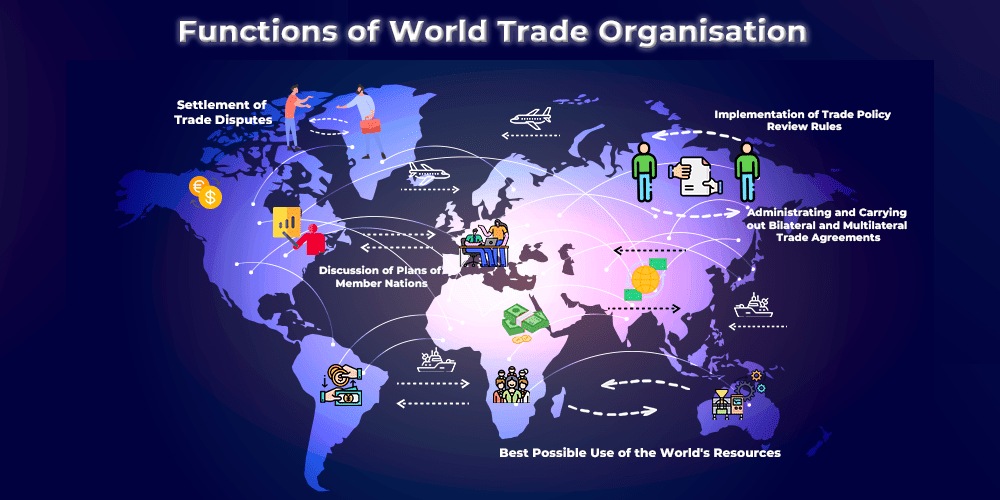
Ministerial Conference – The highest decision-making body, meeting every two years.
General Council – Handles daily operations and also acts as the Dispute Settlement Body (DSB).
Trade Policy Review Body – Reviews national trade policies.
Various specialized councils (Goods, Services, TRIPS).
The WTO currently includes over 160 member states, representing the vast majority of global trade.
Core Principles of the WTO Framework
1. Most-Favoured-Nation (MFN) Principle
Under MFN, a country must treat all WTO members equally in trade matters. If one member receives favorable tariff treatment, all others must receive the same benefit.
2. National Treatment Principle
Imported goods must be treated no less favorably than domestically produced goods once they enter the market.
3. Transparency
Members must publish trade regulations and notify the WTO of policy changes.
4. Binding Commitments
Tariff rates and market access commitments are legally binding.
5. Dispute Settlement
Members can challenge violations through a structured legal process.
Major WTO Agreements
1. GATT 1994
Regulates trade in goods and continues the principles of tariff reduction and non-discrimination.
2. General Agreement on Trade in Services (GATS)
GATS governs international trade in services such as banking, telecommunications, education, and tourism.
3. Agreement on Trade-Related Aspects of Intellectual Property Rights (TRIPS)
TRIPS establishes minimum standards for intellectual property protection, including patents, copyrights, and trademarks.
4. Agreement on Agriculture (AoA)
Regulates agricultural subsidies and market access.
5. Anti-Dumping Agreement
Allows countries to impose anti-dumping duties if imports are priced unfairly low.
WTO Dispute Settlement Mechanism
The WTO dispute resolution system is considered one of the most advanced international legal systems.
Steps in Dispute Settlement:
Consultation between parties
Panel formation
Panel report
Appeal (Appellate Body)
Implementation and compliance review
However, in recent years, the Appellate Body has faced operational challenges due to appointment blockages, affecting enforcement effectiveness.
Regional Trade Agreements and Their Impact
While the WTO provides a multilateral framework, countries increasingly rely on regional trade agreements (RTAs).
Examples include:
United States-Mexico-Canada Agreement (USMCA)
Regional Comprehensive Economic Partnership (RCEP)
Comprehensive and Progressive Agreement for Trans-Pacific Partnership (CPTPP)
These agreements often include deeper commitments beyond WTO standards, such as labor protections, environmental standards, and digital trade provisions.
Global Trade Policies and Protectionism
International trade policies vary depending on national economic strategies. Some countries promote free trade, while others adopt protectionist measures such as:
Tariffs
Import quotas
Subsidies
Safeguard measures
Export restrictions
Recent geopolitical tensions and supply chain disruptions have increased strategic trade interventions worldwide.
Emerging Issues in International Trade Law
1. Digital Trade and E-Commerce
The rise of digital platforms has created new legal questions regarding:
Cross-border data flows
Digital taxation
Data localization
Cybersecurity standards
Negotiations on e-commerce rules continue within the WTO framework.
2. Environmental Sustainability and Climate Trade Measures
Countries are introducing carbon border taxes and sustainability-linked trade regulations, raising concerns about compatibility with WTO rules.
3. Trade and National Security
National security exceptions are increasingly invoked to justify trade restrictions, creating legal tensions within the WTO framework.
4. Supply Chain Resilience
Post-pandemic strategies focus on diversification and reshoring, influencing global trade flows and regulatory approaches.
5. Developing Countries and Special & Differential Treatment
Developing nations receive flexibility under WTO agreements, but debates continue regarding eligibility and fairness.
Role of International Trade Law in Economic Development
International trade law promotes:
Market access
Economic growth
Foreign investment
Technology transfer
Job creation
For developing countries, integration into the global trading system can significantly boost economic development, provided domestic reforms align with global commitments.
Challenges Facing the WTO
The WTO faces several structural challenges:
Stalled multilateral negotiations
Dispute settlement paralysis
Rising trade wars
Expansion of regional trade blocs
Lack of consensus on reform
Reform proposals include strengthening dispute resolution, updating rules for digital trade, and improving transparency mechanisms.
Importance of Compliance for Businesses
Companies engaged in international trade must:
Understand tariff classifications
Monitor anti-dumping measures
Ensure compliance with trade sanctions
Follow customs documentation requirements
Track regulatory changes in export markets
Non-compliance can result in heavy penalties, trade bans, and reputational damage.
Future of International Trade Law
The future of global trade governance will likely include:
Digital trade agreements
Climate-aligned trade rules
Supply chain security frameworks
Reformed dispute settlement system
Greater integration of sustainability and labor standards
Multilateral cooperation remains essential to prevent fragmentation of the global economy.
Conclusion
International Trade Law WTO Framework , anchored in the WTO framework, remains the backbone of global economic governance. Despite emerging geopolitical tensions, digital transformation, and environmental challenges, the multilateral trading system continues to provide legal certainty and stability for global commerce.
Understanding WTO agreements, dispute mechanisms, and evolving global trade policies is essential for legal professionals, policymakers, and businesses navigating the complex landscape of international trade in 2026 and beyond.